
B2b Support Desk
Tenant-aware B2B customer support platform built with Laravel, Inertia, Vue, Sanctum, PostgreSQL, Redis queues, Reverb, and Tailwind-inspired admin and portal UI.
Tech Stack :
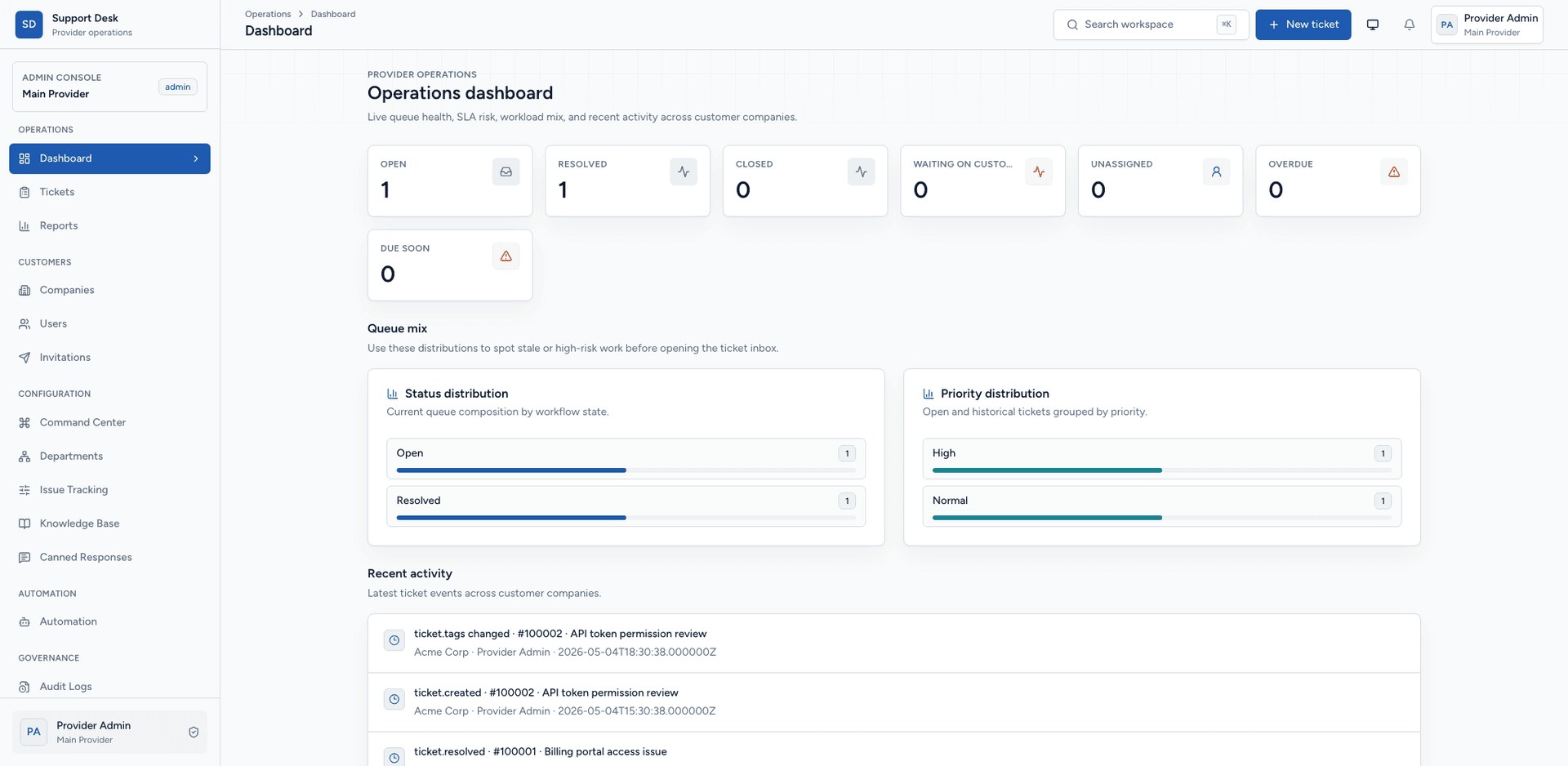
Support Desk
Tenant-aware B2B customer support platform built with Laravel, Inertia, Vue, Sanctum, PostgreSQL, Redis queues, Reverb, and a shadcn/Tailwind-inspired admin and portal UI.
Implemented Production Core
- Provider admin console and customer portal
- Provider Command Center for platform health, customer workspaces, configuration coverage, and quick admin actions
- Tenant-scoped companies, users, roles, invitations, tickets, comments, attachments, API tokens, webhooks, and audit logs
- Company-based 24/7 SLA policies with first-response and resolution breach tracking
- Real dashboard metrics for provider operations and customer portal workspaces
- Attachment allowlist validation with file type and size limits
- Invitation revoke/resend and user role/status management
- Webhook delivery visibility, test delivery, manual retry, and secret rotation
- API v1 ticket endpoints with idempotent ticket creation, OpenAPI documentation, and company-gated Swagger UI
- Company-scoped human ticket numbers such as , with numeric portal/admin ticket URLs and legacy public-id redirects
- Database + mail notification center with header inbox dropdown, read/unread filters, and a full notifications archive
- Personal and shared saved ticket views for admin and portal ticket lists
- Provider bulk ticket actions for status, assignment, priority, and tags
- Public knowledge base for portal/API clients plus provider-managed internal content
- Provider canned responses with ticket/requester/company variables
- Ticket comment mentions with ticket-access scoping
- Provider ticket merge and split workflows with ticket events and audit logs
- CSAT surveys sent on first resolution, with single-use token responses
- Synchronous CSV/PDF exports for ticket and CSAT reports
- Async report center with queued CSV/PDF exports, history, status, download, and errors
- Knowledge base v2 with category hierarchy, article edit/delete, version history, and portal helpful feedback
- Provider automation rules with trigger/condition/action execution logs
- Provider-agnostic inbound email webhook for Mailgun/Postmark/SendGrid/generic payloads with dedupe
- Laravel Reverb/Echo private channels for live notification, ticket, report export, and webhook delivery updates
- Global header search across tickets, comments, companies, users, and knowledge base with tenant scoping and PostgreSQL full-text indexes where supported
- CSAT resend/reminder support plus summary metrics on reports
- Webhook public delivery IDs, payload viewer, custom test payloads, audit filters/detail/CSV export
- Attachment security through MIME, extension, and size allowlists
- Portal branding settings and user notification delivery preferences
Setup
The default example environment expects PostgreSQL, Redis, and the PHP Redis extension. For a lightweight local-only run without Redis, set and in .
Create or update a provider admin:
Run the local app, queue workers, Reverb, logs, and Vite:
If you change , , or any value, restart so Laravel and Vite both read the new environment.
Operations
SLA breaches are marked by the scheduled command:
In production, run Laravel scheduler every minute and keep queue workers alive for the , , , , and queues. Start Reverb when .
The scheduler marks SLA breaches and requeues stale report exports:
Attachment upload validation is configured with:
Inbound email webhooks are available at:
Set to require . Messages are matched by company payload/default company, sender email, and ticket numbers like .
Reverb local configuration:
Keep unless is running; otherwise the browser will try to connect to port .
API
API clients are managed from the customer portal. Use bearer tokens against .
The OpenAPI description is available at docs/openapi.yaml.
Interactive Swagger UI is available at for provider admins and for client companies with API docs access enabled.
Provider admins can enable or disable client-company API docs access from company detail pages and the Command Center.
Ticket creation supports an optional header. Reusing a key with the same body returns the stored response; reusing it with a different body returns a validation error.
Default API token abilities now include ticket creation/read/comment, attachment upload, public knowledge base read, company-safe bulk ticket updates, report exports, and CSAT writes. requires either or .
Webhook deliveries are signed with:
The signature payload is using the endpoint secret.
Verification
Production Checklist
- Configure with , , a stable , PostgreSQL, Redis, mail, storage, and .
- Run and create the first provider admin with .
- Run a queue worker for and run Laravel scheduler every minute.
- Start Reverb only when , then set before building assets.
- Keep and writable by the PHP process.
- Review attachment MIME, extension, and max-size allowlists before enabling customer uploads.
- Verify , login, ticket create/comment, report export, webhook retry, and notification delivery after deploy.
- Back up PostgreSQL and persisted attachment/report storage on the same retention schedule.
- Run , , , and in CI before release.
Roadmap
The current production workflow roadmap is implemented. Future work can focus on report scheduling, richer article approval workflows, provider-facing API clients for operational actions, and deeper full-text search ranking.